

(This is a stock photo, not a photo of the author)
Recently I completed two years as the coordinator of Moms of Pre-Schoolers (MOPS – recently renamed “The MomCo”) at my church. At the last meeting, my co-coordinators, knowing that words of affirmation are one of my love languages, all gave incredibly heartfelt, loving speeches about me. They said how I am always so quick with a scripture or to get a group praying over one another. My friend Kelsey said I held up a lantern for her when she was lost, and that lantern was Jesus. It’s 100% the best thing anyone has ever said about me. It made me cry, but also, near the end of all these amazing speeches, I began to fear that everyone was going to get the wrong idea about me. I wanted to interrupt and yell “I’m not that person!” Because I’m really not. I’m not this godly paragon of virtue. I’m steeped in sin and profoundly broken. All of these blog posts about Jesus, I wrote them to myself, in hopes others could identify with my brokenness and find help from Jesus like I did. I’m quick with scripture because, even though I accepted Christ when I was seven, I didn’t read the whole Bible all the way through for THIRTY YEARS. I completed my first trip through the Bible in July of 2021, having started it in 2019. I read through the whole thing again in 2023 and I’m now on my third go-round, this time my husband is reading with me. So when I’m talking to someone about something hard they’re going through, an encouraging scripture pops out of my mouth because I probably just noticed it for the first time, or probably just understood it for the first time.
I don’t abide with Christ because I’m so pious, I abide with Christ the way a drowning person abides with a lifeguard who is putting them into a life boat. I was drowning in the sea of life, and he saved me. I’m tossing out scriptures like life preservers to other people who are also treading water up to their necks. Jesus saved me in so many incredible ways, how could I possibly not share him with others? How could I sit in my lifeboat and not offer an oar to other struggling people? I’m not up here because I’m so great at swimming. No, way. If I was, I wouldn’t need a lifeboat. If I was pious and perfect, I wouldn’t need Jesus.
I went to Mexico last month on a gospel-sharing mission trip to a refugee camp in Reynosa. In preparation for this I took a gospel conversations training course at my church and one of the techniques we learned is the 15 second testimony, basically like a super short elevator pitch about why we trust in Jesus. The format is simple: “I used to be _______, but then I learned about what Jesus did for me, and now I’m _______.” I struggled with it though because my path to Jesus hasn’t been a straight line but a series of missed exits, u-turns, out-in-left-field detours and back-tracking to Jesus with my tail between my legs. I definitely identify with the younger son in the parable of the prodigal son. I fail to live up to my status as a saved person daily. Every day. I lose my temper, behave selfishly, and put my trust in my own ego and vanity. I’m so painfully aware of my deep, desperate need for a savior. What’s more, I don’t know how to not be this way. To be clear, no one is demanding perfection of me. One of the things I love so much about my church is that no one pretends to be perfect. Our pastor recently gave a sermon about how stingy he used to be. He described a lifetime as a miser, and how God had saved him from that. Another pastor gave a sermon about how he had struggled with internet pornography. I have been pretty open on this blog about my alcoholism, and I told my table at MOPS at that last meeting, “I hope one day I can just sit on the front lawn of the church with all my closet skeletons on full display and proclaim, Look at all this death Christ has saved me from!” I’m not there yet, but I’m getting there.
Ever since I did a step study for codependency I have been telling people how confession is a blessing. First John tells us, “If we confess our sins, he is faithful and just and will forgive us our sins and purify us from all unrighteousness.” (1 John 1:9 NIV)
People use the term “Satan” as if it’s a name, but actually, “Satan” is a title, it means “the accuser”. We feel guilt and shame when we sin because Satan is accusing us, but if you accept the free gift of salvation from Jesus, then Satan’s accusations will ring hollow. Once you accept Christ as your savior, your debt is paid. Because of Jesus, confession is a gift, a blessing. It doesn’t have to be formal, in a confession box, to a priest, although you’re certainly welcome to do it that way if that’s most comfortable to you. James 5:16 just says that we should confess our sins to one another; “Therefore confess your sins to each other and pray for each other so that you may be healed. The prayer of a righteous person is powerful and effective.” (NIV). I have found this to be true. The first time I confessed my alcoholism it took me literally almost a full year to work up the courage to say it out loud, but now it just comes out of my mouth with no preface or warning, and certainly without shame.
I know that many people feel like they have to be sinless before coming to church, probably because somewhere in their past they experienced great shame or scorn from someone in a position of authority at a church. It wouldn’t have to be a pastor, it could just be a snobby, judgmental church lady, or an angry, condemning church man. But the idea that you need to be sinless before entering church is like thinking your car needs to be spotless before bringing it to a car wash, or that you should be perfectly healthy before setting foot inside a hospital. Hospitals are for sick people, car washes are for dirty cars, and churches are for sinners. Jesus is the only one who can take away our sin and shame and replace it with glory and joy, and it’s not a one time thing, it’s a moment by moment need that we have for our savior. To be clear – salvation – that is the act of accepting Christ as your savior – only needs to happen once in your life, but repentance – that is seeking help from God to turn away from sin – needs to happen daily, if not hourly.
The song “Come Thou Fount” is one of my favorite hymns of all time because it speaks to our continuous need for repentance. Read the words below and I’ll explain the meaning in case the 19th century language is hard for you to interpret.
Come, thou Fount of every blessing;
tune my heart to sing thy grace;
streams of mercy, never ceasing,
call for songs of loudest praise.
Teach me some melodious sonnet,
sung by flaming tongues above;
praise the mount! I’m fixed upon it,
mount of thy redeeming love!2 Here I raise my Ebenezer;
hither by thy help I’ve come;
and I hope, by thy good pleasure,
safely to arrive at home.
Jesus sought me when a stranger,
wandering from the fold of God;
he, to rescue me from danger,
interposed his precious blood.3 O to grace how great a debtor
daily I’m constrained to be!
Let thy goodness, like a fetter,
bind my wandering heart to thee.
Prone to wander, Lord, I feel it,
prone to leave the God I love;
here’s my heart, Lord, take and seal it;
seal it for thy courts above.
The song is about the author wrestling with his own depravity, and his realization of his great need for Christ. I identify with this hymn because it acknowledges that we are the ones who wander from God, not Him from us. There is an often-repeated, if possibly apocryphal, story about the songwriter, Robert Robinson, that sometime after penning this wildly successful hymn, he was confronted on a train by a woman who found him to be an unfortunate soul in need of God’s guidance, and she shared his own song with him as a manor of witnessing. Whether or not that story is true, I have experienced wandering from the fold of God often enough to identify with it, and it’s a relatable story to many people.
So if you find the language difficult, allow me to dissect the lyrics; the first verse is praise and worship, asking God to teach the singer how to praise Him. The second verse acknowledges the singer’s rescue from a life of sin, and the third verse begs God to bind the singer to himself as if he were literally chained to God.
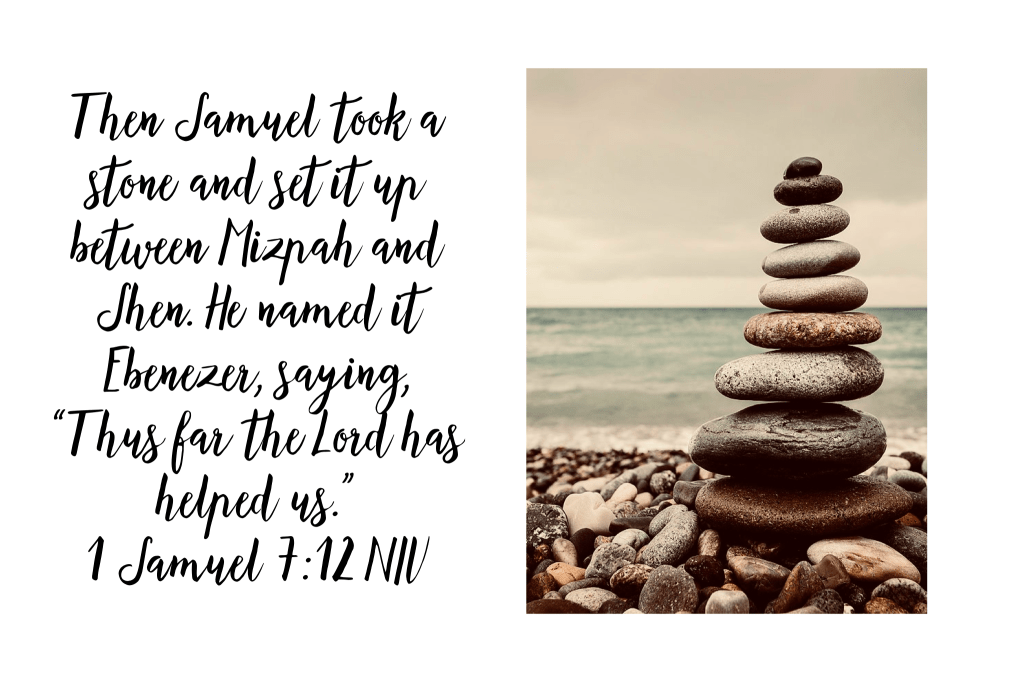
The word “Ebenezer” comes from the Hebrew phrase “Eben-Ezer” which means “stone of help”. In 1 Samuel 7:12 we find Samuel setting up an Ebenezer to commemorate the Lord granting the Israelites victory over the Philistines.
“Then Samuel took a stone and set it up between Mizpah and Shen. He named it Ebenezer, saying, “Thus far the Lord has helped us.”
1 Samuel 7:12 NIV
The songwriter seems to be stating that the song itself is his Ebenezer, his stone of help, to commemorate how God saved him from his sin. He further states that Jesus went looking for him when he knew nothing of Christ’s sacrifice.
The opening line of the final verse, “O to grace how great a debtor daily I’m constrained to be,” though it seems to lament, is actually a resounding shout of joy. It’s hard to explain to someone who has never felt it, but it is exceedingly joyful to be in God’s debts. To be constrained by His love is not a prison to enslave you, but a fortress to protect you.

The next line says “let thy goodness, like a fetter, bind my wandering heart to thee,”. A fetter is a chain locked to a person’s ankle. I know, you’re probably thinking, Liz, you*just* stated that God’s love is not a prison, what’s with the ankle chains? To answer that I want to reexamine the second part of that line, “Bind my wandering heart to thee”, he is asking God to prevent him from walking away from God. The very next line confirms this, “Prone to wander, Lord I feel it, prone to leave the God I love,” and it ends with the heartfelt plea, “Here’s my heart, Lord, take and seal it, seal it for thy courts above”.
That’s why this hymn is one of my all-time favorites. I too, need God to bind my wandering heart to Him. I can’t trust myself not to sin. Even Paul struggled with repeated sin. Check out this segment of Romans 7:
“We know that the law is spiritual; but I am unspiritual, sold as a slave to sin. I do not understand what I do. For what I want to do I do not do, but what I hate I do. And if I do what I do not want to do, I agree that the law is good. As it is, it is no longer I myself who do it, but it is sin living in me. For I know that good itself does not dwell in me, that is, in my sinful nature. For I have the desire to do what is good, but I cannot carry it out. For I do not do the good I want to do, but the evil I do not want to do—this I keep on doing. Now if I do what I do not want to do, it is no longer I who do it, but it is sin living in me that does it. So I find this law at work: Although I want to do good, evil is right there with me. For in my inner being I delight in God’s law; but I see another law at work in me, waging war against the law of my mind and making me a prisoner of the law of sin at work within me. What a wretched man I am! Who will rescue me from this body that is subject to death? Thanks be to God, who delivers me through Jesus Christ our Lord! So then, I myself in my mind am a slave to God’s law, but in my sinful nature a slave to the law of sin.”
Romans 7:14-25 NIV
So you see, according to the Bible, we are powerless to stop sinning on our own. We are enslaved to our sin. Our only deliverance comes through Jesus. He is the one who unlocks the fetter, and gives us the key, we are then free to chain ourselves to God instead, if we choose to do so. That’s what I try (and fail) to do on a daily basis. I am constantly jumping out of that life boat, trusting in my own ability to swim.
So in case anyone heard those speeches and thought they could never be as good of a Christian as me, please recognize that you’d have to reach downward into a pit of sin to be like me, not upward toward piety and perfection. I am profoundly broken, and yet redeemed by Christ. Jesus is the lantern, Jesus is the lifeboat, he is the only one who can save.
Jesus answered, “I am the way and the truth and the life. No one comes to the Father except through me.”
John 14:6 NIV
I’m always open to talk about Jesus or to have real conversations about life’s struggles so if you’re reading this and have questions please feel free to reach out.
 Lone Star Liz
So true for all of us – not unwarranted praise necessarily, but knowing that no matter what anyone else thinks, we are daily aware of how far short we fall of God’s standard. There would be no hope at all, were it not for Jesus. I thank God every day for your gift of writing to help others understand how much He loves them. He makes it very clear that we don’t have to earn His love through our own merits and could never do it, no matter how hard we tried. Thank God for grace.
LikeLiked by 1 person
Amen! And thank you!
LikeLike