

It was over a year ago when I felt prompted to write this blog about the biblical phrase “God is my fortress” I already knew a little bit about ancient fortifications from visiting Windsor Castle in England in 2019, but I researched more and, in doing so, I found the Tower of David in Jerusalem. Well, on December 3, 2022, I saw it with my own eyes.

We had arrived in Jerusalem and were staying at the Dan Panorama which is just a short walk from the old city. Our pastor suggested we walk down and take a look around since the Jaffa gate was only about 15 minutes away by foot. So my husband and I set out with another member of our tour and after some confusion, we found the Jaffa gate and walked through.

No sooner had we emerged from the busy loud highway sidewalk steps into the stone streets of old Jerusalem than we were confronted with the edifice of the tower of David. I was overcome at the sight of her; tall and stately, imposing and ancient. I hadn’t intended to visit the tower since we were on a group trip that had nearly every minute planned out, so just stumbling upon it was a serendipitous and joyful experience. I recognized it at once from this picture:
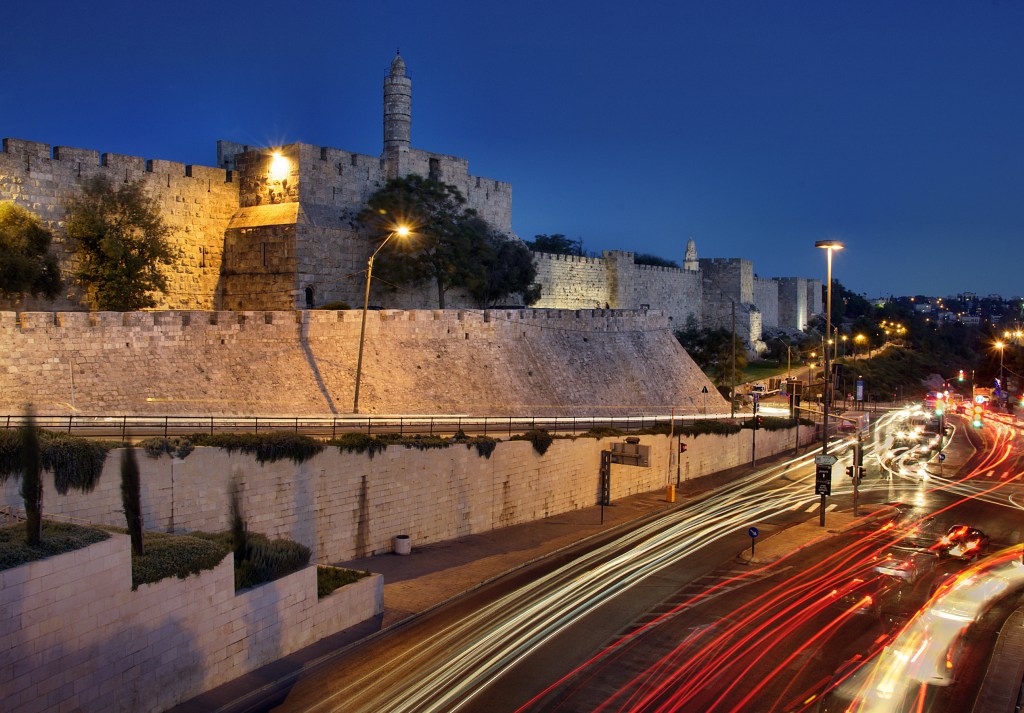
Being a history nerd like I am, I got unreasonably excited at the nearness of this fortification that previously I had only ever written about. So three days later, on the last day of our trip, we had about half a day to ourselves before we needed to pack up and board the bus back to the Tel Aviv airport, so I begged my mom and Eric to spend that time there, and they graciously acquiesced.
The Tower of David, also known as The Citadel of David, has structures that date back as far as 2,500 years. It changed hands multiple times over the centuries (as did the entire city of Jerusalem, but is most often associated with Herod the Great. Herod I is still known for his extensive building projects throughout Israel. He is also somewhat infamous, being credited with ordering the murder of the innocents in the Bible. Though Herodian scholars tend to disbelieve that story, it’s widely accepted that he ordered the execution of his own wife and at least two of his sons.

This is the entrance gate to the citadel of David. When you see how massive the walls to the fortress are, it makes it easier to understand how Rahab could have lived in the walls of Jericho (see Joshua 2:15).

Inside the entrance hangs a Chihuly sculpture, below, another Chihuly work, “Glass Grass”.

One fascinating aspect of ancient fortresses are the defensive measures. Below is an arrow slit in the exterior wall of the Citadel. Known as loopholes, these slits were built into the thick fortress walls to allow archers to pepper invading forces with arrows. From the outside, the loophole is narrow, which makes it a difficult target for marauders, but from the inside, the space is triangular to allow castle archers room to draw back their bows and angle them up and down. In some fortresses the loopholes are cross-shaped to allow for lateral aiming as well. These features – narrow slits in otherwise fortified walls, are where the contractual phrase “to find a loophole” comes from.


The ancient city of Jerusalem has been inhabited for more than 5,000 years by multitudes of middle eastern and some western cultures. At the citadel of David you can find models of the city as it appeared during different phases of history. The city changed vertically; that is to say that when inhabitants wanted to build something new, they would often simply cover the old settlements with sand, of which there is a preponderance in Israel. What this means is that underneath many modern structures there are buried older and older habitations. For this reason, it’s difficult to build even a parking lot because once crews begin to excavate they often discover historically significant ruins. You can see an example of this in the Tower of David, below the ground level of the Herodian fort are chambers from earlier palaces.

Aquaducts brought fresh water to the city, and it was stored in these stone cisterns. A broken or cracked cistern would leak water, or the water could become contaminated with sewage or dirt, making it unfit for bathing, laundry, or human consumption. Understanding that helped me to better comprehend Jeremiah 2:13 – “My people have committed two sins: They have forsaken me, at the spring of living water, and have dug their own cisterns, broken cisterns that cannot hold water.” Jesus also referred to a spring of living water in John 4 and John 7, saying that if we believe in him, he will become a spring of living water flowing out from us.

An olive tree inside the Tower of David.

An olive press inside the tower of David.
Visiting the Tower of David was a delightful surprise and a wonderful, educational experience. I feel very fortunate to have had the chance to visit it and see so much history in person.
 Lone Star Liz
Great memories and nice connections, Liz. Thanks so much for having invited me to share that with you and Eric and the other members of your church. Today at our school, our pastor did a foot washing ceremony at chapel for the children. I don’t think they will ever forget it.
LikeLiked by 1 person
It was an honor to be in Israel and be baptized with you and Eric!
LikeLiked by 1 person