
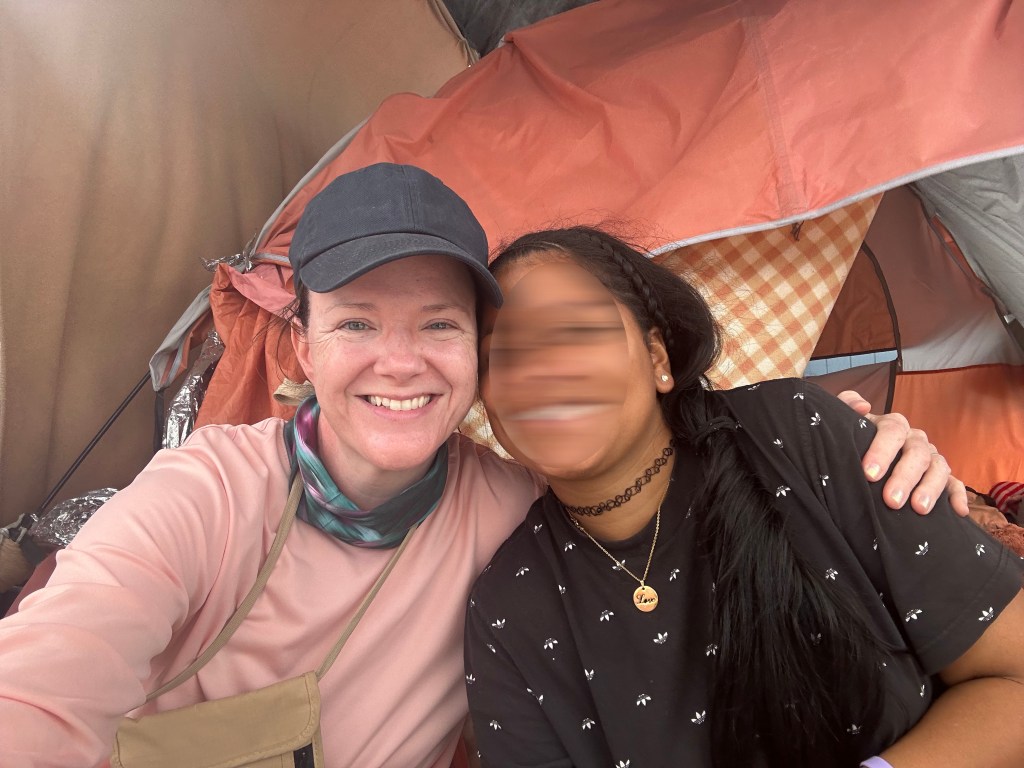
In April of this year I went with a group from my church to a refugee camp in Reynosa, Mexico. I was only there for three days, but I came away completely changed by the experience. We spoke with dozens of people who had faced so many trials and sacrificed so much to travel to the border. I met one young woman in particular whose story broke my heart. Maria* is only 20 years old but she has endured enough peril for several lifetimes. She made it to the border from Venezuela (a journey of about 4,000 miles) by boat, bus, and walking. She recounted climbing a mountain using only a rope for support. When she arrived in Mexico, she was befriended by some unscrupulous people who later betrayed her, and at one point she was kidnapped by the cartel. She survived that and ended up in the refugee camp, within sight of the U.S. I felt how badly she missed her family and how scared she was.
We read about the immigration crisis every day in the news, but meeting and speaking with the actual humans behind the stories is a completely different experience. At dinner one evening I was talking with my fellow missionaries about the border violence, about drugs that move across the border from Mexico to the U.S., and the guns that had traveled across the border from the U.S. to Mexico via Operation Fast and Furious, and how the cartels and cartel influence had infiltrated nearly every level of government in Mexico. We came to the conclusion that we have the same problem on the American side of the border as on the Mexican side of the border: sin.
A few weeks after we got back from Mexico, our pastor gave a sermon which blew my mind, and I haven’t stopped thinking about it since. In the sermon he spoke about when Jesus renamed Simon Peter at Cesarea Phillipi, and the incredible statement he made afterwards. Just read the passage below:
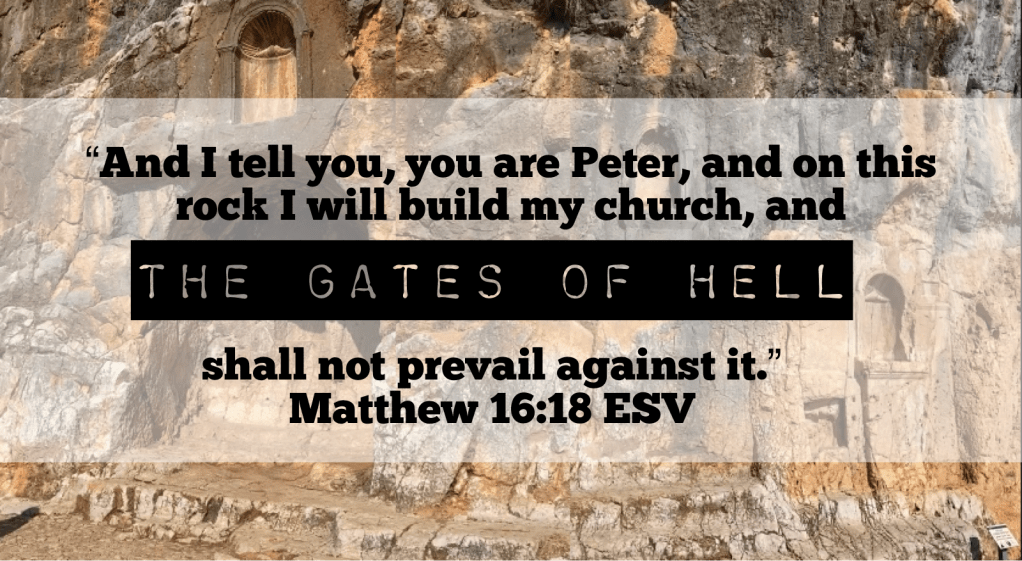
13 Now when Jesus came into the district of Caesarea Philippi, he asked his disciples, “Who do people say that the Son of Man is?” 14 And they said, “Some say John the Baptist, others say Elijah, and others Jeremiah or one of the prophets.” 15 He said to them, “But who do you say that I am?” 16 Simon Peter replied, “You are the Christ, the Son of the living God.” 17 And Jesus answered him, “Blessed are you, Simon Bar-Jonah! For flesh and blood has not revealed this to you, but my Father who is in heaven. 18 And I tell you, you are Peter, and on this rock[b] I will build my church, and the gates of hell[c] shall not prevail against it.
The mind-blowing part of my pastor’s sermon highlights this part of the scripture: on this rock I will build my church, and the gates of hell shall not prevail against it. When gates do not prevail, when gates fail, it’s because they’ve been attacked. That’s not a defensive stance for the church. That’s an offensive stance.
What I took from that is this: what if Jesus is telling us that the church will barge into the most desolate, hopeless places, break down the gates and declare freedom to the captives within? What if the church is the battering ram that breaks through the gates of hell, releasing people held in bondage to sin? How would that change your ministry? If you knew at the start that Christ is victor, could that abolish fear for you?
Start the video at the 24:54 mark to hear Dr. Matt Cassidy in his own words on the topic:
When Jesus showed up in first century Israel, doing great works, performing miracles and claiming to be the Messiah, the anointed son of God, he was met with scorn and disgust from the Pharisees and the Sadducees (the religious leaders of the day). The popular interpretation of messianic prophecy at the time was that the Messiah would be a great military leader who would free the Jewish people from the Roman occupation. They thought he would defeat Rome, not be a peacemaker, turning the other cheek and teaching people to love their enemies. That’s not what a conqueror looks like. We all know a conqueror wears armor, is formidable, frightening, and carries a sword. He rages against injustice and makes his enemies a footstool for his feet. We can’t really imagine the crushing blow it must have been for the disciples when Jesus was himself crucified by the Roman oppressors.
If that had been the end of the story it would have been bleak indeed, but Jesus didn’t stay dead. The resurrected Christ appeared to around 500 people. Those people then went on to spread Christianity, and the Christians believed they were so free in Christ that they willingly gave up their lives for their faith. It’s a well-established fact that the Romans used to feed Christians to Lions in the coliseum for entertainment. The infamous emperor Nero is said to have used Christians as torches for his parties. But despite the threat of death, Christianity continued to spread in Rome. Within two centuries Rome itself discarded polytheism and committed its entire empire to Christianity. The Roman empire created the Roman Catholic Church, and then spread Christianity to all corners of the globe. So, in that sense, Christ did defeat Rome, he just didn’t do it with swords, he did it with words, and with love, and with peace, because that’s the power of God, to defeat entire empires not with weapons of war but with love and peace.
And what if that is also our charge? Christ built his church on Peter, Petros, the rock. David used a rock to take down Goliath, and Jesus is using a rock to take out the gates of hell, and we get to be a part of it. We get to share the gospel with people who don’t know Christ, we get to tell them that he can rescue them from any sin that entangles them. Knowing Christ is freedom, knowing Christ is healing, and through Christ we are made whole.
So does that mean that we walk headfirst into danger? In some cases, maybe. This life is not the end of what God has for us, and He has certainly led some people into dangerous places, but that doesn’t mean we are all called to that. Rather, we are all called to make disciples of all nations. We are all called to share Christ with people, and when you can’t do that, you can pray. You can pray God’s protection over the people serving in perilous places, and you can pray for strongholds to crumble. When viewed this way, it becomes obvious that sin has captives in the cartels, people stuck in a cycle of violence, for whom fear is their master and daily companion. Sin also has captives in your neighborhood, people like me, held hostage by silent addictions, seeming to all the world like a normal suburban mom, but locked in a prison of alcoholism. The good news of Christ is the key to unlocking the cells of sin, no matter the circumstance. If you’re reading this, and you are imprisoned by sin, you can turn to Christ right now, before another moment passes, you can repent of your sin and ask for Him to save you from your prison. In Christ, there is freedom. All you have to do is accept him.
* a pseudonym to protect her identity
 Lone Star Liz